Showing posts with label *South Africa. Show all posts

Thursday, May 2, 2013

Shosholoza


I've just discovered Shosholoza.

Although the original author of the song is unknown, Shosholoza is a traditional miner's song, originally sung by groups of men from the Ndebele ethnic group that travelled by steam train from their homes in Zimbabwe to work in South African's diamond and gold mines. The Ndebele live predominantly in Zimbabwe (formerly, Rhodesia) near its border with South Africa, and they can also be found in the northern border of South Africa.The song mixes Ndebele and Zulu words and is Zimbabwean in origin even though the two ethnic groups are very similar.Some people argue that the song describes the journey to the mines in South Africa, while others say it describes the return to Zimbabwe. It is also sometimes sung "stimela si phume Rhodesia". According to cultural researchers Booth and Nauright, Zulu workers later took up the song to generate rhythm during group tasks and to alleviate boredom and stress.The song was sung by working miners in time with the music beat as they were swinging their axes to dig. It was usually sung under hardship in 'call and response' style (one man singing a solo line and the rest of the group responding by copying him).It was also sung by prisoners in call and response style using alto, soprano part divided by row. Former South African President Nelson Mandela describes how he sang Shosholoza as he worked during his imprisonment on Robben Island. He describes it as "a song that compares the apartheid struggle to the motion of an oncoming train" and goes on to explain that "the singing made the work lighter".

In contemporary times, it is used in varied contexts in South Africa to show solidarity in sporting events and other national events to relay the message that the players are not alone and are part of a team.

This a-capella version is particularly fun. Enjoy!

Shosholoza | Kulezo ntaba | Stimela siphume South Africa
Wen' uyabaleka | Kulezo ntaba | Stimela siphume South Africa

A rough translation:
Go forward, on those mountains, train to South africa
You are running away, on those mountains, train to South Africa

Thursday, April 25, 2013

Red Cappuccino

I've turned into a red cappuccino fan and have been ordering cup after cup with reckless abandon. I imagine Mma Ramotswe would fancy a cup herself, after a long day! Here is an excellent post about the drink along with a simple recipe.


Thursday, April 18, 2013

The Elephant Whisperer

What's better than a book about a conservationist in Africa? A book about him adopting a rogue elephant herd, of course!

Lawrence Anthony devoted his life to animal conservation, protecting the world's endangered species. Then he was asked to accept a herd of "rogue" wild elephants on his Thula Thula game reserve in Zululand. His common sense told him to refuse, but he was the herd's last chance of survival: they would be killed if he wouldn't take them.

In order to save their lives, Anthony took them in. In the years that followed he became a part of their family. And as he battled to create a bond with the elephants, he came to realize that they had a great deal to teach him about life, loyalty, and freedom.

The Elephant Whisperer is a heartwarming, exciting, funny, and sometimes sad memoir of Anthony's experiences with these huge yet sympathetic creatures. Set against the background of life on an African game reserve, with unforgettable characters and exotic wildlife, Anthony's unrelenting efforts at animal protection and his remarkable connection with nature will inspire animal lovers and adventurous souls everywhere. 
Source: The Elephant Whisperer on Amazon.

Thursday, April 11, 2013

ZA vs. SA

Ever wondered why the South African rand is represented by ZAR instead of SAR and why South African websites have a .co.za extension?

As expected, wikipedia provided me with za answer:
None of the official names for South Africa can be abbreviated to ZA, which is an abbreviation of the Dutch Zuid-Afrika. This is a legacy of when Dutch was an official language in South Africa, before being replaced by Afrikaans, in which the name of the country is Suid-Afrika. Afrikaans joined English and Dutch as an official language of South Africa in 1925 in a synonym-status with Dutch, and in the South African Constitution of 1961 Dutch was removed as an official language altogether and replaced by Afrikaans. In 1983 Dutch lost its synonym-status with Afrikaans. However, the .sa domain is used by Saudi Arabia and ZAR is the ISO 4217 currency code for the South African Rand. The international vehicle code for South Africa has been ZA since 1936.

Thursday, April 4, 2013

NeighbourGoods Market

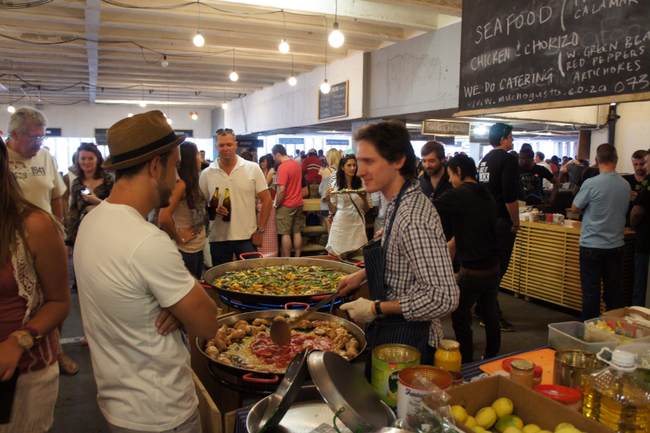
Located in Braamfontein, in the heart of the inner city, the NeighbourGoods Market is open every Saturday from 9AM to 3PM. The market covers 2 floors of an airy building and has multiple stalls setup by various food vendors including  local farmers, fine-food purveyors, organic merchants, bakers and distributors, grocers, mongers, butchers, artisan producers, celebrated local chefs, and micro enterprises. There were plenty of options to choose from: Pizza, Thai, Mexican, Paella and many more. The market was buzzing with activity and reminded us of Madrid's Mercado San Miguel.
We tried some interesting African vegetarian food, sampled all sorts of sauces, cheeses, and chocolate and ended up buying some delicious hummus and olives. The dessert stalls looked wonderful - crepes, cupcakes, Belgian waffles and more. There were also several options for drinks, wine, beer and among others, spiked tender coconut water (two shots of rum went straight into the coconut!). The open rooftop area was a great place to hang out.
An excellent local experience. There are also some nice art galleries and cafés in the area, in case you want to go on a leisurely post-prandial stroll.

Official Website.  Pictures. More pictures.

Thursday, March 21, 2013

Constitution Hill

 In South Africa, Human Rights Day is celebrated on 21 March, in remembrance of the Sharpeville massacre which took place on the same day in 1960. This massacre occurred as a result of protests against the Apartheid regime in South Africa. Human Rights Day seemed like the perfect day to visit Constitution Hill and learn more about South Africa's history.


Constitution Hill Precinct in Braamfontein Johannesburg has a very complex history going back to 1892 when the Old Fort was built under the Zuid Afrikaanse Republiek. Functioning as a prison, except for the brief period of the South African War (1899-1902) when it was a military defence post, new buildings were added to the site in the late 1900s and early 20th Century: the so-called Natives’ section and isolation cells known as Sections Four and Five where black male prisoners were held, a Women’s Prison (1907), and an Awaiting Trial building (1920s).

All these buildings together were known as the Fort, a place that was notorious for its harsh treatment of prisoners: who ranged from common criminals to hundreds of thousands of ordinary men and women who contravened colonial and apartheid legislation such as hut tax laws, beer brewing laws, pass laws and the Group Areas act. Many political prisoners were also incarcerated at the Fort. Boer military leaders were imprisoned during the South African war 1899-1902. In 1906 and 1913 Indian passive resisters (including Mahatma Gandhi) were incarcerated. Read more here.

                                     'The Accused': One of the sculptures displayed outside the Constitutional Court

Constitution Hill is now the seat of the Constitutional Court of South Africa. The first court session in the new building at this location was held in February 2004. Outside the court building is an enormous sign in 11 official languages. You enter through the impressive 9m wooden doors that feature plaques carved with words and sign-language symbols conveying the 27 rights enshrined in the Constitution. Upon entering you find yourself in a spacious hall with decorated pillars designed like trees (memories of Sagrada Familia!), honoring the age old African tradition of seeking justice under the trees.

We loved the simple design of the court which was so different from the more common ornate styles. The bricks you see towards the back are part of the old fort building and were used in the building to show history, solidarity, and the strength of old and damaged bricks when put together. The walls have glass sections to show that transparency is greatly valued. The beautiful beaded South African flag in the court was another highlight of the tour.


Wednesday, March 20, 2013

The Languages of South Africa


South Africa has 11 official languages (and scores of unofficial ones):
  1. Afrikaans
  2. English
  3. isiNdebele
  4. isiXhosa
  5. isiZulu
  6. Sesotho sa Leboa (Pedi/Sepedi)
  7. Sesotho
  8. Setswana
  9. siSwati
  10. Tshivenda
  11. Xitsonga
  12. Indigenous creoles and pidgins   


South Africa's linguistic diversity means all 11 languages have had a profound effect on each other. South African English, for example, is littered with words and phrases from Afrikaans, isiZulu, Nama, and other African languages. And African-language speakers often pepper their speech with English and Afrikaans.
Most South Africans are multilingual, able to speak more than one language. Most South Africans speak English, which is fairly ubiquitous in official and commercial public life. The country's other lingua franca is isiZulu.

 Constitutional Court Sign in 11 languages!

In terms of linguistic classification, the official languages include two West-Germanic languages (English and Afrikaans) and nine Bantu languages. Four of these are Nguni languages (Zulu, Xhosa, Swati and Ndebele) and have many similarities in syntax and grammar and three are Sotho–Tswana languages (Northern Sotho, Southern Sotho and Tswana). Tsonga is a Tswa–Ronga language.

Here are some great free online language courses offered by UNISA (University of South Africa). Salani kahle!


Notes from Wiki and South Africa.info

Saturday, March 16, 2013

Hartbeespoort

This morning, we woke up very early and drove to Hartbeespoort, informally known as "Harties", a small resort town in the North West Province of South Africa, situated on the slopes of the Magaliesberg mountain range and the banks of the Hartbeespoort Dam. The name of the town means "pass of the hartbees" (a species of antelope) in Afrikaans. It was previously known as Schoemansville, named after General Hendrik Schoeman (1840 - 1901), a Boer General in the Anglo-Boer War who owned the farm that the dam was built on. The dam was originally designed for irrigation which is currently its primary use. It is fed by the waters of the Crocodile and Magalies rivers.
Picture from intotravel.co.za
So, why did we wake up so early? To make it in time for Om Die Dam ('Around the dam'), the annual 50k ultra marathon (they also have a half-marathon and a 5k). The sun hid behind the clouds and granted us some beautiful running weather. The 5k path led us through quiet, hilly residential streets with beautiful homes (most with barking dogs, who seemed ready for the annual onslaught of morning pedestrians).

After the run, we walked to the Hartbeespoort Aerial Cableway (apparently the longest monocableway in Africa) and took a ride to the top for a spectacular panorama of the town, the calm waters and the endless mountains.

Monday, March 11, 2013

Searching for Sugar Man

It was only fitting that the first film we watched South Africa was ‘Searching for Sugar Man’. The documentary is about an American singer, Rodriguez, whose two albums released in the 1970s failed miserably in the US. He gave up on his musical career and went back to his mundane life of construction work.

Somehow, unbeknownst to him, the albums made their way to South Africa and Rodriguez became immensely popular over the years. He was a household name; his albums treasured as much as Michael Jackson’s or the Beatles’. But nobody in South Africa knew anything about him, and presumed him dead. The movie is about a South African fan (later joined by others), who set out on a long journey looking for, and eventually finding Rodriguez.

The movie is very well-made, with some lovely shots of Cape Town, and is accompanied by the poignant music and lyrics of Rodriguez.

Saturday, March 9, 2013

The Beauty of the Irrational

"The Beauty of the Irrational" follows Ryan Sandes, a South African Ultra-Runner, as he returns to the Fish River Canyon to run the 5 day, 84km, Fish River Canyon Hiking Trail in the fastest time possible. He completed the run, self-supported, in amazing time of 6h57min! Thanks for sharing, H.

The Beauty of the Irrational from The African Attachment on Vimeo.

Monday, March 4, 2013

Elegant Artwork

I loved today's Google Doodle celebrating Miriam Makeba's 81st Birthday. Here is my favourite song by her, Soweto Blues.
Happy Birthday, Mama Africa!

Saturday, March 2, 2013

Hello Madiba!

First stop, Nelson Mandela Square, a large shopping center in Johannesburg. Looking up at a 6-metre statue of Madiba is simply wonderful!

Tuesday, February 19, 2013

Xhosa

Xhosa is one of the official languages of South Africa. Xhosa is spoken by approximately 7.9 million people, or about 18% of the South African population. Like most Bantu languages, Xhosa is a tonal language, that is, the same sequence of consonants and vowels can have different meanings when said with a rising or falling or high or low intonation. One of the most distinctive features of the language is the prominence of click consonants; the word "Xhosa" begins with a click.

Xhosa is written using a Latin alphabet. Three letters are used to indicate the basic clicks: c for dental clicks, x for lateral clicks, and q for post-alveolar clicks . Tones are not indicated in the written form.

[From Wikipedia]

Here is a short video about Xhosa Tongue Twisters; a good introduction to the three types of basic clicks in the language:

Saturday, February 9, 2013

RSA Factfile

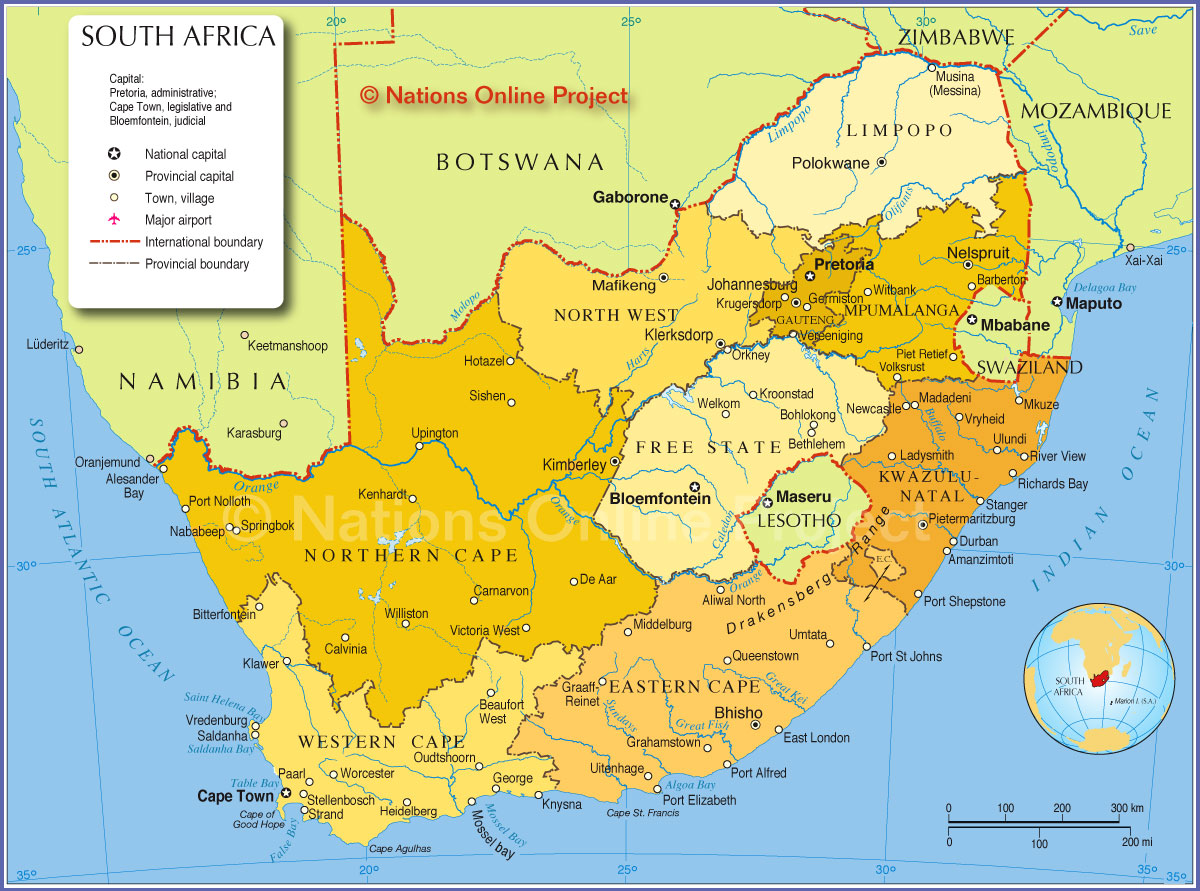
Here is a beautiful map of South Africa. Let's get some basic facts about the nation together:

1. The Republic of South Africa is divided into nine provinces: Eastern Cape, Free State, Gauteng, KwaZulu-Natal, Limpopo, Mpumalanga, North West, Northern Cape and Western Cape

2. While the executive capital is Pretoria, Blomfontein is the judicial capital and Cape Town the legislative.

3. Population is about 52 million (2011 census)

4. The largest cities are Johannesburg and Soweto in Gauteng Province and Cape Town in Western Cape Province, in that order.

Meanwhile, H has been sending me some excellent information about South Africa. Read on:

Sunday, October 17, 2010

Hugh Masekela - Live!


Click on the concert pictures above to see them better!


Last night, I had the privilege of seeing Hugh Masekela live in concert at Carnegie Hall. It was a wonderful evening. Hugh is tremendously entertaining; it is hard to believe he is over 70, he has the energy of a 30 year old! His voice boomed strong across the auditorium and the music was divine! He has a fantastic sense of humor and he regaled us with stories and anecdotes, the best of which was about his true origins in New Orleans and his real identity, "Bo Diddley!". His friend Morris Goldberg's saxophone and flute additions were great, I really enjoyed them. By the way, Hugh can really make fun of an audience!

He danced, he sang, he joked, he played. It was fantastic! One of my favorites from his playlist last night:

Thursday, May 6, 2010

46664

If you ever wondered what 46664 meant, here's an excerpt from the Wiki Page:
Mandela was imprisoned on Robben Island in 1964, and was the 466th prisoner to arrive that year. The prison administration's scheme of numbering prisoners was to follow the sequence number of the prisoner (466 in his case), with the last two digits of the year (64). The number was imposed on him by the prison for over 25 years, until his release in 1990. "Prisoner 46664" continues to be used, as a reverential title for him, and the Nelson Mandela Foundation uses 46664.com as its website address. Read more about the concerts.

Tuesday, April 13, 2010

Art

H brought back this beautiful handmade bracelet from Cape Town.

Tuesday, April 6, 2010

Of Travels

Check out this beautiful travel slideshow that features Africa right from the beginning (KwaZulu Natal and Zambia). My husband will identify with this, he just did the bungee jump at Victoria Falls. He brought back some wonderful photos and I will post selected ones shortly.

Monday, March 15, 2010

The blog turns one!


Has it been a year already? Learning about this beautiful continent, its interesting culture, peoples and politics has given me much joy. Over and over again, I have been enthralled by its natural beauty, horrified by its cruel practices and intrigued by all the diversity and richness it has to present.

All year I have felt a deep wanderlust, a yearning to travel the length and breadth of Mama Afrika. Much to my dismay, I have had to experience some disappointment in my attempts to get closer to Africa - Last year, I missed an Amadou and Mariam concert by 30 minutes (I had never heard of them), today, as FdAf turns one, my husband is off on a two week trip to South Africa, Zambia and Botswana (unfortunately, my schedule does not permit me to join him) and finally, I have to skip a Kidjo concert in two weeks (I bought tickets six months ago) because I have a mid-term early the next morning. But these are very minor things. Africa is all around you, no matter where you are.


I am eager and hopeful for that moment, when I set foot on African soil. I leave you with a beautiful number from Vusi Mahlasela, Basimanyana which I hope you will enjoy. Here's to year one!

Monday, January 25, 2010

Nelson Mandela's Biography

Solve small shared these wonderful 5 minute clips that capture the highlights of Nelson Mandela's extraordinary life.


Direct Links: Part 1 and Part 2