Showing posts with label Culture. Show all posts

Thursday, May 2, 2013

Shosholoza


I've just discovered Shosholoza.

Although the original author of the song is unknown, Shosholoza is a traditional miner's song, originally sung by groups of men from the Ndebele ethnic group that travelled by steam train from their homes in Zimbabwe to work in South African's diamond and gold mines. The Ndebele live predominantly in Zimbabwe (formerly, Rhodesia) near its border with South Africa, and they can also be found in the northern border of South Africa.The song mixes Ndebele and Zulu words and is Zimbabwean in origin even though the two ethnic groups are very similar.Some people argue that the song describes the journey to the mines in South Africa, while others say it describes the return to Zimbabwe. It is also sometimes sung "stimela si phume Rhodesia". According to cultural researchers Booth and Nauright, Zulu workers later took up the song to generate rhythm during group tasks and to alleviate boredom and stress.The song was sung by working miners in time with the music beat as they were swinging their axes to dig. It was usually sung under hardship in 'call and response' style (one man singing a solo line and the rest of the group responding by copying him).It was also sung by prisoners in call and response style using alto, soprano part divided by row. Former South African President Nelson Mandela describes how he sang Shosholoza as he worked during his imprisonment on Robben Island. He describes it as "a song that compares the apartheid struggle to the motion of an oncoming train" and goes on to explain that "the singing made the work lighter".

In contemporary times, it is used in varied contexts in South Africa to show solidarity in sporting events and other national events to relay the message that the players are not alone and are part of a team.

This a-capella version is particularly fun. Enjoy!

Shosholoza | Kulezo ntaba | Stimela siphume South Africa
Wen' uyabaleka | Kulezo ntaba | Stimela siphume South Africa

A rough translation:
Go forward, on those mountains, train to South africa
You are running away, on those mountains, train to South Africa

Thursday, April 25, 2013

Red Cappuccino

I've turned into a red cappuccino fan and have been ordering cup after cup with reckless abandon. I imagine Mma Ramotswe would fancy a cup herself, after a long day! Here is an excellent post about the drink along with a simple recipe.


Thursday, April 4, 2013

NeighbourGoods Market

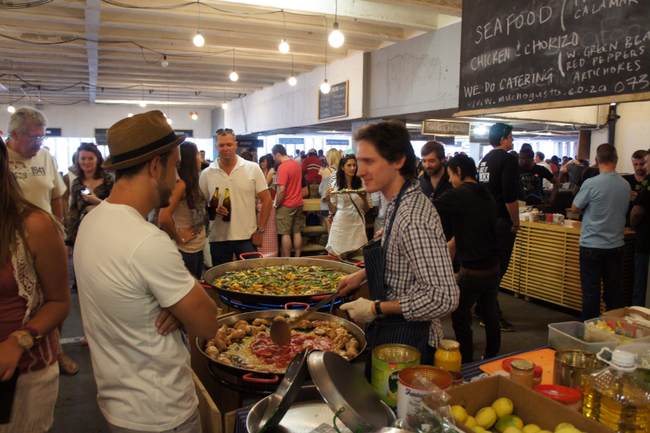
Located in Braamfontein, in the heart of the inner city, the NeighbourGoods Market is open every Saturday from 9AM to 3PM. The market covers 2 floors of an airy building and has multiple stalls setup by various food vendors including  local farmers, fine-food purveyors, organic merchants, bakers and distributors, grocers, mongers, butchers, artisan producers, celebrated local chefs, and micro enterprises. There were plenty of options to choose from: Pizza, Thai, Mexican, Paella and many more. The market was buzzing with activity and reminded us of Madrid's Mercado San Miguel.
We tried some interesting African vegetarian food, sampled all sorts of sauces, cheeses, and chocolate and ended up buying some delicious hummus and olives. The dessert stalls looked wonderful - crepes, cupcakes, Belgian waffles and more. There were also several options for drinks, wine, beer and among others, spiked tender coconut water (two shots of rum went straight into the coconut!). The open rooftop area was a great place to hang out.
An excellent local experience. There are also some nice art galleries and cafés in the area, in case you want to go on a leisurely post-prandial stroll.

Official Website.  Pictures. More pictures.

Friday, March 8, 2013

African Folk Tales

At the library today, I came across a McCall Smith book with an interesting title, ‘The girl who married a lion’. The book is a collection of short African Folk Tales from Zimbabwe and Botswane. The stories feature people and animals (which talk, of course!). As McCall Smith puts it so nicely in the introduction, the stories draw us into “a fascinating world view in which the boundaries between the animal and human worlds are indistinct and fluid”. The idea is very much along the lines of Aesop’s fables and Panchatantra stories but the stories are completely different from the ones I grew up with, featuring a totally different landscape and culture.
Of course, I had already decided to read it once I realized it had a foreword by good old Mma Ramotswe! Now, who can resist her solid recommendations? ;)

Thursday, November 1, 2012

Djamakoyo

These days, I constantly find myself singing, humming or whistling the melodious 'Djamakoyo' by talented Malian musician, Adama Yalomba. This song is from his album Kassa and I am looking forward to discovering the other tracks on it. For now, here's Djamakoyo
The little booklet accompanying this excellent Putumayo CD states that Yalomba sings, "Whether you're a farmer, a fisherman or a breeder / Work from the heart / Let us do our work with compassion / If you keep working only for yourself, you remain alone".
Live version here.

Wednesday, May 23, 2012

Karibu to Bangalore!


Jambo, my friends! Yesterday, I had the pleasure of spending the day with a group of 21 from Nairobi, Kenya. Visiting India for a short program over 9 days, the students had a day off before they went back to Kenya. Sr. Maria Sheila (my primary school Headmistress), who is now based in Kenya told me about their trip and I was eager to show them around Bangalore. 
The Carmel Blossoms Group at Lal Bagh

The Tour:
I picked the group up from my school campus and we headed straight to LalBagh Botanical Gardens. It was a warm, sunny day (a little too hot for some of the children, all of whom are between 11 and 13 years of age). After a quick tour of the KempeGowda tower on the hill which has a nice view, the glasshouse, the snow white clock and the topiary garden, we headed towards the center of the city. We picked up lunch at Ice & Spice on St. Mark's road and enjoyed it leisurely in the gardens of Cubbon Park under the shade of the tall trees. My friend Asha joined us and we chatted with Sr. Winifred and Sr. Maria Villa who are leading the group on this tour. I enjoyed the conversation very much as they talked to us about life in Kenya. I remembered my trip to Kenya last year fondly and remembered some of my favourite Swahili words too!
 At the Kempegowda Tower on the hill at Lal Bagh

After lunch we walked into the beautiful Sheshadri Iyer public library (which is almost a 100 years old) to gawk at the giant collection of books and periodicals. Our next stop was UB City Mall where we went to see another side of Bangalore and of course, to use their luxurious bathrooms! Next stop was the Visveswaraiah science museum which was fascinating - it even had a 3D show which I hadn't heard of! After driving past the Vidhana Soudha and High Court Building, we went to Commercial Street and Jayanagar 4th block where the girls had fun shopping for gifts, shoes and clothes. We managed to drink some fresh sugarcane juice too! It was a long and fun day. It was also my first time as a tour guide and I enjoyed it, especially because of the good company. :)

Just after lunch, in the shade of the trees at Cubbon Park

Some Special Moments:
One of the girls lost her money (about Rs.2000) at the museum, as her bag was open and with such a big crowd there, I am not surprised that it was stolen. She seemed quite dejected but wait! As soon as we got into the bus, Sr. Winifred said a magic word "Harambey!". Immediately, 100 rupee notes appeared and within a minute or two, funds were pooled together and the girl got her money back. I was amazed. "What is Harambe?", I asked. Harambe is Swahili for "working together in unity" or "let's pull together". Following Kenya's independence in 1963, the first Prime Minister of Kenya, Jomo Kenyatta adopted "Harambee" as a concept of pulling the country together to build a new nation. He encouraged communities to work together to raise funds for all sorts of local projects. This is still a strong and widely used concept in Kenya. What a beautiful idea! We should use it too, no?


Towards the end of the day as we headed back home on the bus, a few of the guests came forward to say a few words. They were very kind and I felt happy to hear that they had enjoyed the day. But the best part was when they decided that they would send blessings my way and all of a sudden, in unison, they burst into song, "Ubarikiwe! Ubarikiwe!" (May you be blessed). All their strong voices blended together in beautiful harmonies and I was touched. A truly memorable moment. 


I got big hugs from the children at the end of the day! :) I feel lucky to have had such a wonderful opportunity - to have spent the day with such a warm, genuine and caring group of people. I hope the children went back with happy memories from India.

Ubarikiwe!

Thursday, June 9, 2011

Kibera's Healers

A very interesting set of pictures about the slum healers in Kenya's Kibera slum.

Thursday, October 28, 2010

Tanzanian Tribes

So wonderful to watch this BBC clip about the peaceful co-existence of multiple tribes in Tanzania. Also, some cultural insights into life in Dar es Salaam.

Sunday, October 17, 2010

Hugh Masekela - Live!


Click on the concert pictures above to see them better!


Last night, I had the privilege of seeing Hugh Masekela live in concert at Carnegie Hall. It was a wonderful evening. Hugh is tremendously entertaining; it is hard to believe he is over 70, he has the energy of a 30 year old! His voice boomed strong across the auditorium and the music was divine! He has a fantastic sense of humor and he regaled us with stories and anecdotes, the best of which was about his true origins in New Orleans and his real identity, "Bo Diddley!". His friend Morris Goldberg's saxophone and flute additions were great, I really enjoyed them. By the way, Hugh can really make fun of an audience!

He danced, he sang, he joked, he played. It was fantastic! One of my favorites from his playlist last night:

Thursday, October 14, 2010

Greeting in Rwanda

Here is the South Indian semi-celebrity Wilbur Sargunaraj showing us how to greet in Kinyarwanda. Entertaining and informative.


Disclaimer: Not sure if the spellings are entirely accurate.

Thursday, April 15, 2010

Yé ké yé ké


Mory Kanté (born March 29, 1950 in Kissidougou, Guinea) is an acclaimed vocalist and player of the kora harp. He was born into one of Guinea's best known families of griot (hereditary) musicians. After being brought up in the Mandinka griot tradition in Guinea, he was sent to Mali at the age of seven years – where he learned to play the kora, as well as important voice traditions, some of which are necessary to become a griot.

Kanté is best known internationally for his 1987 hit song "Yé ké yé ké", which was one of Africa's best-ever selling hits as well as being a European Number One in 1988 making it the first ever African single to sell over one million copies. Kanté received unexpected fame again in 1994 when the German techno duo Hardfloor created a dance remix of "Yéké Yéké." He also appeared in 2006 as vocalist on British DJ Darren Tate's release, "Narama". More at Wiki.

Official Website.

Merci, H.

Sunday, April 11, 2010

Lost in Translation

Here's an interesting NPR article our Prof. shared with us. It draws a comparison between people in London and the semi-nomadic Himba people of the Kaokoland region in Northern Namibia to bring out the similarities and differences in culture, particularly sounds associated with emotions.

Friday, April 9, 2010

Henna in Sudan

Here's an interesting BBC slideshow about the importance of Henna in Sudanese culture. Also, check out this website about Sudanese traditions (and its henna page).

Tuesday, April 6, 2010

Naming my daughter

A friend shared this interesting piece and it reminded me of a recent BBC article about naming children in Africa. Not to forget the wonderful punning capabilities of the current Nigerian President's name, Goodluck Jonathan. :0)

Naming My Daughter

"In the Uruba tribe of Africa, children are named not only at birth but throughout their lives by their characteristics and the events that befall them."

The one who took hold in the cold night
The one who kicked loudly
The one who slid down quickly in the ice storm
She who came while the doctor was eating dessert
New one held up by heels in the glare
The river between two brothers
Second pot on the stove
Princess of a hundred dolls
Hair like water falling beneath moonlight
Strides into the day
She who runs away with motorcycle club president
Daughter kicked with a boot
Daughter blizzard in the sky
Daughter night-pocket
She who sells sports club memberships
One who loves over and over
She who wants child but lost one.
She who wants marriage but has none
She who never gives up
Diana (Goddess of the Chase)
Doris (for the carrot-top grandmother
she never knew)
Fargnoli (for the father
who drank and left and died)
Peter Pan, Iron Pumper
Tumbleweed who goes mouths without calling
Daughter who is a pillar of light
Daughter mirror, Daughter stands alone
Daughter boomerang who always comes back
Daughter who flies forward into the day
where I will be nameless.

"Naming My Daughter" by Patricia Fargnoli, from Necessary Light. © Utah State University Press, 1999.