Saturday, March 2, 2013

Hello Madiba!

First stop, Nelson Mandela Square, a large shopping center in Johannesburg. Looking up at a 6-metre statue of Madiba is simply wonderful!

Tuesday, February 19, 2013

Xhosa

Xhosa is one of the official languages of South Africa. Xhosa is spoken by approximately 7.9 million people, or about 18% of the South African population. Like most Bantu languages, Xhosa is a tonal language, that is, the same sequence of consonants and vowels can have different meanings when said with a rising or falling or high or low intonation. One of the most distinctive features of the language is the prominence of click consonants; the word "Xhosa" begins with a click.

Xhosa is written using a Latin alphabet. Three letters are used to indicate the basic clicks: c for dental clicks, x for lateral clicks, and q for post-alveolar clicks . Tones are not indicated in the written form.

[From Wikipedia]

Here is a short video about Xhosa Tongue Twisters; a good introduction to the three types of basic clicks in the language:

Sunday, February 17, 2013

Touching Moment

 
1964 | TANZANIA - A touching moment between primatologist and National Geographic grantee Jane Goodall and young chimpanzee Flint at Tanzania’s Gombe Stream Reserve. (Photo by Hugo van Lawick).

From Boston Globe's 125 Years of National Geographic. Thanks for sharing, PR.

Saturday, February 9, 2013

RSA Factfile

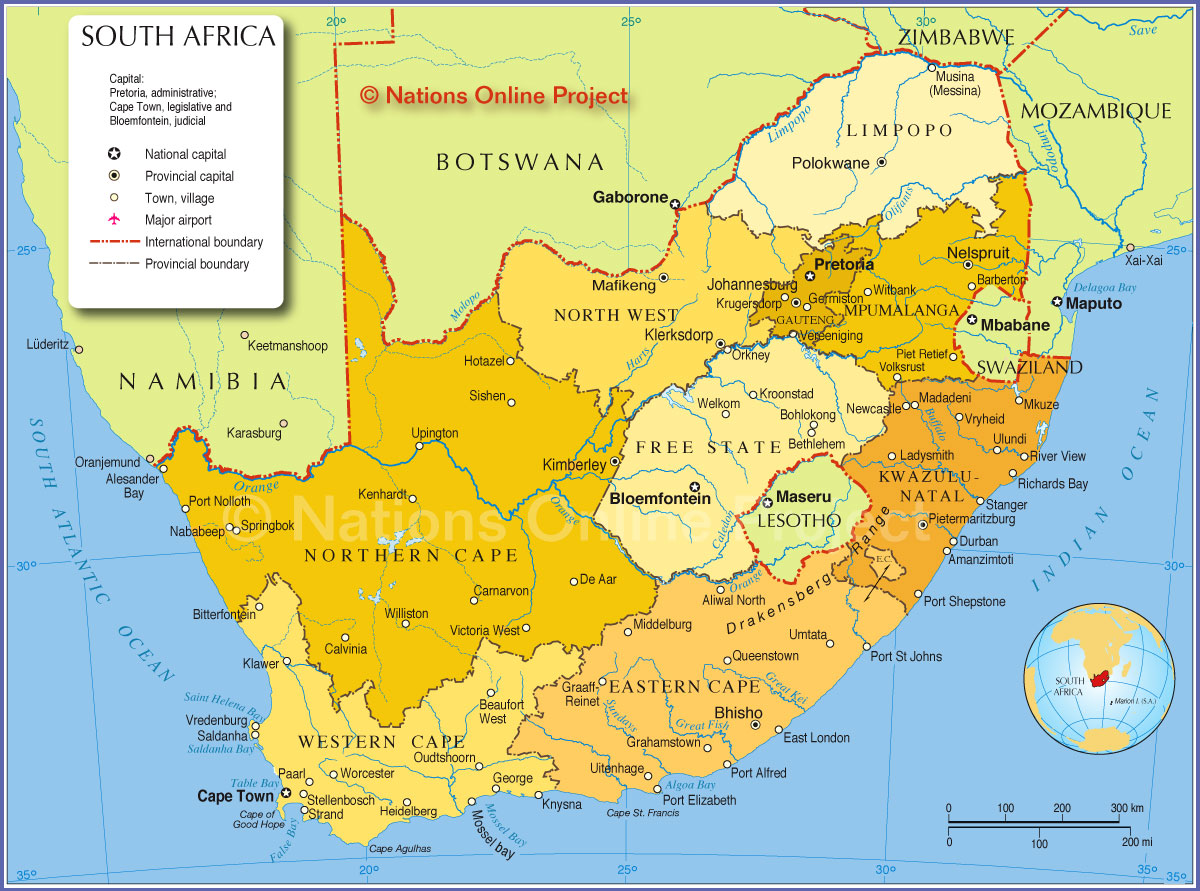
Here is a beautiful map of South Africa. Let's get some basic facts about the nation together:

1. The Republic of South Africa is divided into nine provinces: Eastern Cape, Free State, Gauteng, KwaZulu-Natal, Limpopo, Mpumalanga, North West, Northern Cape and Western Cape

2. While the executive capital is Pretoria, Blomfontein is the judicial capital and Cape Town the legislative.

3. Population is about 52 million (2011 census)

4. The largest cities are Johannesburg and Soweto in Gauteng Province and Cape Town in Western Cape Province, in that order.

Meanwhile, H has been sending me some excellent information about South Africa. Read on:

Thursday, November 1, 2012

Djamakoyo

These days, I constantly find myself singing, humming or whistling the melodious 'Djamakoyo' by talented Malian musician, Adama Yalomba. This song is from his album Kassa and I am looking forward to discovering the other tracks on it. For now, here's Djamakoyo
The little booklet accompanying this excellent Putumayo CD states that Yalomba sings, "Whether you're a farmer, a fisherman or a breeder / Work from the heart / Let us do our work with compassion / If you keep working only for yourself, you remain alone".
Live version here.

Wednesday, May 23, 2012

Karibu to Bangalore!


Jambo, my friends! Yesterday, I had the pleasure of spending the day with a group of 21 from Nairobi, Kenya. Visiting India for a short program over 9 days, the students had a day off before they went back to Kenya. Sr. Maria Sheila (my primary school Headmistress), who is now based in Kenya told me about their trip and I was eager to show them around Bangalore. 
The Carmel Blossoms Group at Lal Bagh

The Tour:
I picked the group up from my school campus and we headed straight to LalBagh Botanical Gardens. It was a warm, sunny day (a little too hot for some of the children, all of whom are between 11 and 13 years of age). After a quick tour of the KempeGowda tower on the hill which has a nice view, the glasshouse, the snow white clock and the topiary garden, we headed towards the center of the city. We picked up lunch at Ice & Spice on St. Mark's road and enjoyed it leisurely in the gardens of Cubbon Park under the shade of the tall trees. My friend Asha joined us and we chatted with Sr. Winifred and Sr. Maria Villa who are leading the group on this tour. I enjoyed the conversation very much as they talked to us about life in Kenya. I remembered my trip to Kenya last year fondly and remembered some of my favourite Swahili words too!
 At the Kempegowda Tower on the hill at Lal Bagh

After lunch we walked into the beautiful Sheshadri Iyer public library (which is almost a 100 years old) to gawk at the giant collection of books and periodicals. Our next stop was UB City Mall where we went to see another side of Bangalore and of course, to use their luxurious bathrooms! Next stop was the Visveswaraiah science museum which was fascinating - it even had a 3D show which I hadn't heard of! After driving past the Vidhana Soudha and High Court Building, we went to Commercial Street and Jayanagar 4th block where the girls had fun shopping for gifts, shoes and clothes. We managed to drink some fresh sugarcane juice too! It was a long and fun day. It was also my first time as a tour guide and I enjoyed it, especially because of the good company. :)

Just after lunch, in the shade of the trees at Cubbon Park

Some Special Moments:
One of the girls lost her money (about Rs.2000) at the museum, as her bag was open and with such a big crowd there, I am not surprised that it was stolen. She seemed quite dejected but wait! As soon as we got into the bus, Sr. Winifred said a magic word "Harambey!". Immediately, 100 rupee notes appeared and within a minute or two, funds were pooled together and the girl got her money back. I was amazed. "What is Harambe?", I asked. Harambe is Swahili for "working together in unity" or "let's pull together". Following Kenya's independence in 1963, the first Prime Minister of Kenya, Jomo Kenyatta adopted "Harambee" as a concept of pulling the country together to build a new nation. He encouraged communities to work together to raise funds for all sorts of local projects. This is still a strong and widely used concept in Kenya. What a beautiful idea! We should use it too, no?


Towards the end of the day as we headed back home on the bus, a few of the guests came forward to say a few words. They were very kind and I felt happy to hear that they had enjoyed the day. But the best part was when they decided that they would send blessings my way and all of a sudden, in unison, they burst into song, "Ubarikiwe! Ubarikiwe!" (May you be blessed). All their strong voices blended together in beautiful harmonies and I was touched. A truly memorable moment. 


I got big hugs from the children at the end of the day! :) I feel lucky to have had such a wonderful opportunity - to have spent the day with such a warm, genuine and caring group of people. I hope the children went back with happy memories from India.

Ubarikiwe!

Tuesday, November 15, 2011

Kenyan Safari

Visiting Amboseli National Park and Lake Nakuru National Park in August 2011 were unforgettable experiences. Seeing all the majestic animals roam the land freely, without chains and cages, now that was a real thrill. I first experienced it when I went whale watching in Cape Cod and this time around I felt it in a stronger way. Hundreds of elephants and other animals ambling about, free to do as they please and go where they want. Peaceful co-habitation. Freedom.


Alert


Majestic Tembo


Splendid Sunset


Wildebeest at Twilight


Full set of pictures here.

Friday, November 11, 2011

Giraffe Centre

The Giraffe Centre in Nairobi, Kenya was started to protect the endangered Rothschild giraffe and to help breed it in captivity. The program has been very successful.


It is a wonderful place to interact with giraffes from a raised platform. Not only do you get to observe them at very close quarters but you are also allowed to feed the giraffes little treats made from molasses by hand! They seem to love them enough to play a game of tennis-watch for them. See for yourself:


It's surreal being so close to so many of these tall beauties. I learned that they are intelligent creatures, they actually respond to their names!


Most intriguing however, was the fact that their saliva is so antiseptic that their mouths are perpetually clean. In fact, they eat leaves from the thorny acacia since the thorn wounds heal rapidly owing to the antispectic nature of the saliva!


Here are some pictures from our trip there. You will also see some happy warthogs who enjoy the treats that the giraffes drop.


Giraffe Centre

Saturday, October 29, 2011

Taraab Music

Taarab is a music genre popular in Tanzania and Kenya. It is influenced by music from the cultures with a historical presence in East Africa, including music from East Asia, Sub-Saharan Africa, North Africa, the Middle East and Europe. Taarab rose to prominence in 1928 with the rise of the genre's first star, Siti binti Saad.

Here is a small piece from a Taarab performance we saw at Monsoon Restaurant in Stone Town, Zanzibar.

Wednesday, October 26, 2011

Blue-Green Beauty

The name Tanzania derives from the names of the two states Tanganyika and Zanzibar that united in 1964 to form the United Republic of Tanganyika and Zanzibar, which later the same year was renamed the United Republic of Tanzania. The Flag of Tanzania was adopted on 30 June 1964. It was a merger of the flags of Tanganyika and Zanzibar.


The Flag of Tanganyika:

The Flag of Zanzibar:
Et Voilà, The Flag of Tanzania:

Saturday, October 22, 2011

The Lone Acacia

I often wondered about the images that pop up when he hear the word 'Africa' (or type it in Google for that matter). Sunsets, giraffes, elephants, lions... and the acacia tree (or two). For me, the image that remained etched in my mind after just a few days at Amboseli, is the image of the lone acacia tree. You turn your head and you see miles and miles of flat land, hills in the distance and directly in view, there it stands, the lone acacia tree. I saw it so often and wondered how the landscape managed so cleverly, to repeatedly bring into view, (with changing backgrounds), just one lone acacia, standing tall.

Saturday, October 8, 2011

Iron Lady wins Nobel


Liberia's President Ellen Johnson Sirleaf wins the Nobel Prize for Peace along with Liberian Leymah Gbowee and Tawakul Karman of Yemen. Congratulations!

Sunday, September 25, 2011

RIP Dr.Wangari Maathai

Goodbye, Prof. Wangari Maathai. We will miss you. Thank you for the inspiration and for all the trees.

Pictures galleries at BBC and Guardian.

Friday, September 23, 2011

Dave Sheldrick


Official Photos from Dave Sheldrick Postcards and Newsletter

The David Sheldrick Wildlife Trust is an orphanage for Baby Elephants. It was started by Daphne Sheldrick to honour the memory of her husband David, who was a great naturalist. The couple served as the wardens of the Tsavo National Park in Kenya.


Baby elephants are orphaned for various reasons - some mothers die of natural causes, poachers are rampant and mothers are brutally killed for ivory while innocent babies look on, some mothers die when herds get caught in the middle of human conflict. However, it should be noted that most elephants are orphaned due to humans and their activities. Each year 19,000 African elephants are killed.


Once found, the baby elephants are brought to DSWT and hand-reared by a group of dedicated staff members using a special formula of milk whice Daphne took years to develop and perfect. After about three years of TLC, the elephants are taken back into the wild and rehabilitated with a herd. As they are young, they are easily accepted by the mother of the herd and the young ones learn to follow the rules of the herd. A noble initiative that is being well carried out. Another place of hope in an ugly world.
I was fortunate to visit the shelter and say hello to some of the sweet elephant babies there. The shelter also cares for rhinos, one of them completely blind, but at peace.


Monday, September 12, 2011

Nzolo, Dearly Beloved

Here is a post by a friend, an excerpt from The Poisonwood Bible by Barbara Kingsolver.