Friday, September 9, 2011

Babies on the Brink

This set of BBC pictures shows babies of endangered species being carefully hand-reared in specialist facilities around the world.


The Coquerel's Sifaka, like all lemurs, is endemic to Madagascar. Madagascar is home to more than 250,000 (5% of the world's plant and animal) species of which 80% are found nowhere else on the globe (including six baobab species).


The Barbary Lion, originally from Morocco, is a Lion sub-species that became extinct in the wild in the 1940s.


The Aye-Aye is also a lemur, the world's largest nocturnal primate, native to Madagascar that combines rodent-like teeth and a special thin middle finger to fill the same ecological niche as a woodpecker.


The final image is an endearing picture of a baby elephant from Kenya's Dave Sheldrick Shelter.

Wednesday, September 7, 2011

Mauritania

Abdoulaye "Laye" Sow is a Senegalese musician. Here is his beautiful track Mauritania:

Monday, September 5, 2011

National Parks Galore

The list of national parks in Kenya and Tanzania is larger than I had imagined! The national park system of Kenya is maintained by the Kenya Wildlife Service. KWS Official Website.

Saturday, September 3, 2011

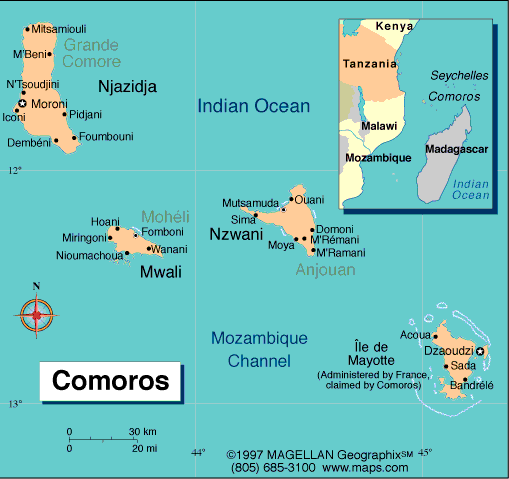
Comoros


At the Africa Inland Mission's Mayfield Guesthouse, we met an American couple on their way to (live and work in) Comoros. We knew nothing about the place, so here we go:

Full name: The Union of the Comoros
Population: 691,400 (UN, 2010)
Capital: Moroni
Area: 1,862 sq km (719 sq miles)
Major languages: Arabic (official), French (official), Comoran/Shikomoro (a blend of Swahili and Arabic)
Major religion: Islam
Life expectancy: 65 years (men), 70 years (women) (UN)
Monetary unit: 1 Comoran franc = 100 centimes
Main exports: Vanilla, cloves, perfume oil, copra
GNI per capita: US $870 (World Bank, 2009)
Internet domain: .km


Geography: The Comoros is formed by Ngazidja (Grande Comore), Mwali (Mohéli), Nzwani (Anjouan), and Maore (Mayotte), the major islands in the Comoros Archipelago, as well as many minor islets. The islands are officially known by their Comorian language names, though international sources still use their French names (given in parentheses above). The capital and largest city, Moroni, is located on Ngazidja. The archipelago is situated in the Indian Ocean, in the Mozambique Channel, between the African coast (nearest to Mozambique and Tanzania) and Madagascar, with no land borders.

Economy: One of the world's poorest countries, Comoros is made up of three islands that have inadequate transportation links, a young and rapidly increasing population, and few natural resources. The low educational level of the labor force contributes to a subsistence level of economic activity, high unemployment, and a heavy dependence on foreign grants and technical assistance. Agriculture, including fishing, hunting, and forestry, contributes 40% to GDP, employs 80% of the labor force, and provides most of the exports. Export income is heavily reliant on the three main crops of vanilla, cloves, and ylang-ylang and Comoros' export earnings are easily disrupted by disasters such as fires. The country is not self-sufficient in food production; rice, the main staple, accounts for the bulk of imports. The government - which is hampered by internal political disputes - lacks a comprehensive strategy to attract foreign investment and is struggling to upgrade education and technical training, privatize commercial and industrial enterprises, improve health services, diversify exports, promote tourism, and reduce the high population growth rate. Political problems have inhibited growth, which has averaged only about 1% in 2006-09. Remittances from 150,000 Comorans abroad help supplement GDP. In September 2009 the IMF approved Comoros for a three-year $21 million loan. The IMF gave generally positive reports of the country's program performance as of October 2010. The African Development Bank approved a $34.6 million debt-relief package loan for Comoros in September 2010, and Comoros will attempt to qualify for debt relief in 2012 under the IMF and World Bank's Heavily Indebted Poor Countries (HIPC) initiative.


Thursday, September 1, 2011

Power Women

From Forbes, The 20 Youngest Power Women in Africa, featuring women of influence from various domains.

Tuesday, August 30, 2011

African Blogs

An extensive list of African Blogs by country. Happy reading!

Sunday, August 28, 2011

28

Stephanie Nolen's 28: Stories of AIDS in Africa is a book of stories, focusing on individuals affected with (or by) HIV and AIDS in Africa. She chose 28 for the 28 million people suffering from this brutal infection in the continent (in 2007). The stories, of miners, doctors, truck drivers, prostitutes, and innocent children, among others, come from different nations in Africa. They bring out the social, cultural and political aspects that influence and are influenced by the rapid spread of HIV. They book features courageous people fighting the disease, those who fight for affordable treatment, those whose professions made them highly susceptible, many others who are victims of circumstances or their own ignorant actions and sadly, many who are helpless and are not being helped by the Govemernments. To learn of the situations in some countries and their nearly non-existant heath system and its infrastructure is frightening.

There is still hope, though. Many have worked hard to set up strong programs that distribute affordable ARV drugs which have turned around the lives of many who had very nearly given up. An excellent book, especially to understand the existing condition of the illness and how it is being dealt with in different nations in Africa. Nevertheless, it is painful to learn how rampant HIV is, how it has played with the lives of millions and destroyed their families and how it continues to do so.

Official Website.

Friday, August 26, 2011

Africa’s Lost Eden

The Gorongosa National Park is located in Mozambique, at the southern end of the Great East African Rift Valley. I learned about it first, from a National Geographic Documentary titled "Africa's Lost Eden". Trailer here.
The film explains how this wondrous park, once abundant with wildlife (and even known as ‘the place where Noah left his Ark’), saw almost all its wildlife completely wiped out due to the long civil conflict in Mozambique. A very large and courageous restoration project is now underway at Gorongosa; led by The Carr Foundation, a U.S. not-for-profit organization, and the Government of Mozambique. An attempt to relocate animals from national parks in other parts of Africa, with a hope that they will , help re-populate Gorongosa and someday bring it back to its former glory.

Official Website. Historic Photo Gallery.

Wednesday, August 24, 2011

Jambo Bwana

Especially on the island of Zanzibar, we heard this catchy song over and over again. From Street vendors with pirated CDs ("Hey Sister! The music of Africa!") to the tree climber who was asked to demonstrate to us the method used to climb a coconut tree, the Zanzibaris sang "Jambo Bwana" to us. See (and hear) for yourself and while you're at it, pick up some basic Swahili too (Lyrics and meaning here). And it's no cliche, you are bound to hear the phrase "Hakuna Matata" used several times a day!

Here is a video of that entertaining coconut man and his rendition of the classic as he makes his way down. Enjoy!


Another version here.

Monday, August 22, 2011

Carte d'Afrique

From travelblog.org, a map of Africa on the wall of a Rwandan school, Nyamata.

Saturday, August 20, 2011

Superb Starling


What an apt name for a bird with such superb colours! The superb starling, which will fly by you a-plenty in Kenya, has stunning, shiny shades of blue-green.

From Jan Nordvalen's beautiful Safari photos.

Friday, August 19, 2011

Unbowed

While I was in Kenya, I read Dr. Wangari Maathai's book, Unbowed. The book is a memoir, the story of her extraordinary life.

Inspired by her interactions with nature as a child, Dr. Maathai went on to become a leading environmentalist. She pioneered the Green Belt Movement, owing to which much of Kenya's forests have been restored, and kept it alive in the face of adversity. Protecting the ecosystem in this manner helped many rural communities fight poverty and become self sufficient. She fought long and hard for many noble causes including multi-party democracy in Kenya and saving the city's central green space, Uhuru (freedom) park. She helped bring out multiple instances of corrpution and the Government turned against her and all her initiatives. Yet, she remained committed to her goals and helped Kenya move forward in many ways, despite her personal struggles and setbacks.

I was inspired to read about her life and the results she brought about from her determination and sheer courage. It was thrilling just to walk around in Uhuru Park, knowing how much had gone into saving it. Through most of the book, I felt as if Dr. Maathai was sitting with me and telling me her heart-warming story. A beautiful read and a great way to learn about Kenya and the story of a phenomenal woman.


From Wikipedia: Wangari Muta Maathai (born April 1, 1940 in Ihithe village, Tetu division, Nyeri District of Kenya) is a Kenyan environmental and political activist. She was educated in the United States at Mount St. Scholastica and the University of Pittsburgh, as well as the University of Nairobi in Kenya. In the 1970s, Maathai founded the Green Belt Movement, an environmental non-governmental organization focused on the planting of trees, environmental conservation, and women's rights. In 1984, she was awarded the Right Livelihood Award, and in 2004, she became the first African woman to receive the Nobel Peace Prize for “her contribution to sustainable development, democracy and peace.” Maathai was an elected member of Parliament and served as Assistant Minister for Environment and Natural Resources in the government of President Mwai Kibaki between January 2003 and November 2005.

Friday, August 5, 2011

Jambo from Nairobi!

And so it came to be that I first stepped onto the African continent in Nairobi and took a deep breath to breathe in the African air. The joy and excitement is indescribable!

After spending most of the day with friends, I visited the National Museum in Nairobi where the information overload about Kenya was overwhelming! My favourite exhibit was of Ahmed, the elephant.

Tuesday, August 2, 2011

Facing the Lion


Reading Facing the Lion: Growing Up Maasai on the African Savanna by Joseph Lekuton is an excellent way to understand the life of the nomadic Maasai tribes of East Africa. I really enjoyed learning about Joseph's childhood and the Ariaal way of life. Some incidents and customs are particularly fascinating, but best of all is Joseph's journey to where he is today. I only wish the book was a little longer. Written for young readers but an excellent read for adults too.

Sunday, July 10, 2011

The Lazarus Effect

Stunning documentary about how $0.40 a day can bring one back to life. Must watch.